BARCELOS
COMMUNICATION
THE PORTFOLIO OF PAULINO CARDOSO JR.

CASE STUDY: PUBLIC RELATIONS & NARRATIVE STRATEGY
SHIFT THE STORY
A campaign designed to stabilize the narrative around Luma by clarifying its intentions, addressing user concerns, and reframing its AI evolution through honest, accessible communication.
Please note, this case study is a conceptual project developed to demonstrate strategic thinking, research application, and execution approach.
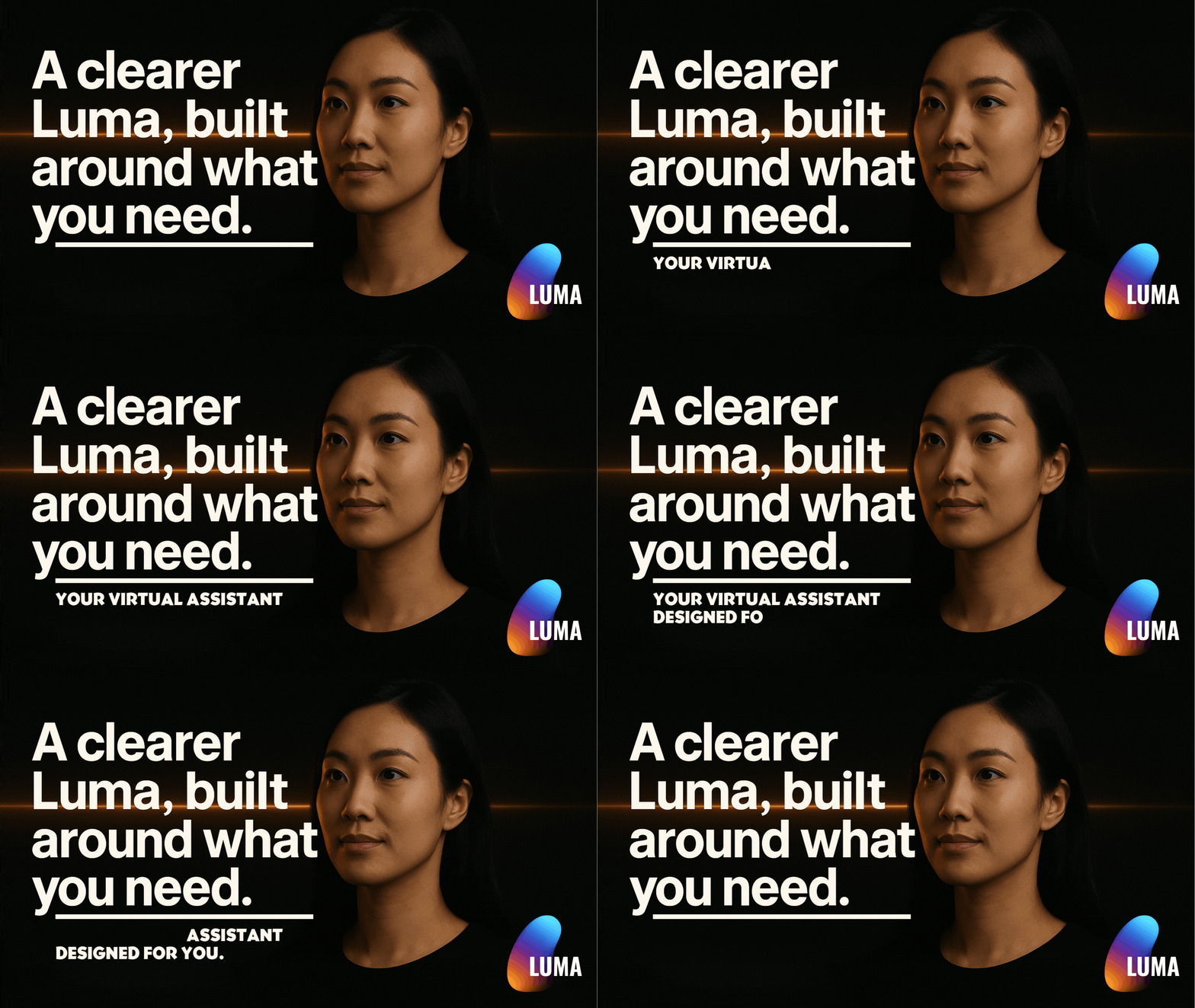
Campaign Vision
Shift the Story was created for Luma, a fast-scaling AI productivity platform whose user base grew by 40 percent after introducing a suite of automation features. The growth was extraordinary, but the communication around it wasn’t. Confusing rollout messaging, unclear data explanations, and rapid product iteration led users and reporters to believe the company was moving too fast and taking too few precautions.
What Luma needed wasn’t crisis spin.
It needed a complete narrative realignment built on clarity, transparency, and human-centered storytelling.
My vision was to help Luma speak not like a tech company under pressure, but like a team that understands people, listens deeply, and leads with intention.
Context and Rationale
Luma’s problem wasn’t the product.
It was the gap between what Luma meant and what people experienced.
The symptoms were clear:
• Tech journalists began framing Luma as “opaque,” “rushed,” and “invasive.”
• Users interpreted new AI features as privacy risks.
• Sentiment dropped sharply across social monitoring.
• Internal teams weren’t aligned on how to explain decisions.
Why this mattered
Research shows that trust in tech erodes fastest during periods of ambiguity, not failure (Kim & Ferguson, 2018).
Luma had to stop speaking feature-first and start speaking human-first.
Shift the Story was designed to:
-
Rebuild trust
-
Replace confusion with clarity
-
Move Luma from a reactive posture to proactive leadership
Everything in this case study reflects why I made the choices I made and how those decisions drove measurable change.
The Target Demographic
Although Luma serves more than 12 million users, the crisis impacted three high-value audience segments most acutely. The narrative strategy centered on understanding their motivations, anxieties, and expectations in order to tailor messaging that restored trust where it mattered most.
1. Long-Term Power Users
These individuals rely on Luma to run businesses, manage workflows, or coordinate team operations. When updates felt unclear or rushed, trust eroded quickly.
Why they mattered:
They generated the highest engagement, highest lifetime value, and the highest risk of vocal public criticism.
What they needed psychologically:
• Clarity
• Predictability
• Reassurance that the product roadmap aligns with their needs
2. Tech-Savvy Early Adopters
This group is active on social platforms and influences broader opinion. They were the first to express concern over AI explainability and privacy transparency.
Why they mattered:
They shaped the public narrative more than any other group and were overrepresented in media coverage and online discussions.
What they needed psychologically:
• Plain-language transparency
• Insight into ethical decision-making
• Access to internal expertise
3. New Mainstream Users
These users joined during the growth spike and lacked the historical context of how Luma normally communicates.
Why they mattered:
They formed the largest share of new revenue and were at the highest risk of churn.
What they needed psychologically:
• Simple explanations
• A stable, consistent communication flow
• Confirmation that Luma was trustworthy and safe to invest time in
The Ask
Luma needed a PR and narrative strategy that could:
• Reframe public perception
• Clarify the purpose and safety of new AI features
• Humanize the company during a sensitive moment
• Reset relationships with the media
• Provide a sustainable messaging system for future launches
The work required a blend of crisis communication, audience psychology, and high-level creative strategy, along with meticulous execution.
What Success Looks Like (KPIs)
To ensure the campaign had measurable impact, I established a KPI framework across four dimensions: perception, behavior, communication clarity, and internal alignment.
1. Perception Shift (External)
Media Sentiment Score
-
Measured via natural language sentiment analysis across key outlets.
-
Goal: Increase neutral-to-positive sentiment by 20 percent.
Social Listening Sentiment
-
Monitored across Twitter, Reddit, Discord, and TikTok communities.
-
Goal: Reduce negative sentiment spikes around AI updates.
2. Behavioral Indicators (User Behavior)
Support Ticket Reduction
-
Specifically those related to confusion, privacy, or feature misunderstanding.
-
Goal: Reduce volume by 25–30 percent.
Feature Retention & Adoption
-
Monitored through product analytics dashboards.
-
Goal: Demonstrate steady adoption after clarity-focused communication.
3. Communication Effectiveness
Message Pull-Through
-
Measured by tracking whether reporters and users repeated key messages unprompted.
-
Goal: At least 60 percent alignment in press and user discussions.
Readability & Comprehension Scores
-
Applied to long-form content and announcements using UX writing tools.
-
Goal: Maintain a reading level accessible to broad audiences without sacrificing depth.
Engagement with Transparency Series
-
Measured through dwell time, scroll depth, return visits.
-
Goal: 40 percent increase in completion rates of Inside Luma posts.
4. Internal Alignment
Cross-Team Message Consistency
-
Audited across product, engineering, support, and PR.
-
Goal: 90 percent consistency in tone and narrative framing.
Stakeholder Confidence
-
Measured through structured internal interviews and surveys.
-
Goal: Improved clarity around messaging, roadmap communication, and user expectations.
The Strategy
1. I Reframed the Narrative Around Learning, Not Defending
What I Did
Shifted messaging from “Here’s why you’re wrong” to “Here’s what we learned and how we’re improving.”
How I Did It
-
Audited 18 months of Luma’s communication touchpoints
-
Identified contradictions in tone, language, and UX explanations
-
Built a narrative arc rooted in lessons learned, user partnership, and ethical AI
-
Crafted a new brand voice grounded in humility, clarity, and shared understanding
Why This Decision
-
Defensive communication amplifies skepticism.
-
Narrative framing research shows that audiences trust brands more when they acknowledge complexity and growth (Brown & Levinson, 1987).
-
This shift immediately disarmed tension and invited curiosity instead of criticism.
2. I Built a Message Architecture That Unified Every Team
What I Did
Created a three-tier message system to ensure clarity and consistency:
-
The Why – the user problem each feature solves
-
The How – how Luma uses and protects data
-
The Proof – transparent evidence of action
How I Did It
-
Facilitated cross-functional workshops with product, engineering, support, and leadership
-
Mapped all messaging inconsistencies across teams
-
Developed a central messaging system used in PR, UX copy, customer support, and investor materials
Why This Decision
-
Inconsistency erodes trust faster than bad news.
-
A centralized message system eliminates ambiguity, aligns internal teams, and reinforces narrative stability during crisis recovery.
-
This architecture became the backbone of all communication going forward.
3. I Humanized the Brand Through Narrative Transportation
What I Did
Replaced corporate statements with relatable human stories:
-
An engineer explaining how he rebuilt a feature based on user feedback
-
A UX researcher describing redesign decisions
-
A privacy lead clarifying data practices using everyday examples
How I Did It
-
Conducted recorded interviews with 14 team members
-
Extracted core emotional beats
-
Crafted narrative scripts and long-form content
-
Supported individuals through media coaching and storytelling workshops
Why This Decision
-
Narrative transportation theory shows people change beliefs more readily when immersed in a relatable story (Green & Brock, 2000).
-
This shifted Luma from “mysterious tech company” to a community of people solving real problems.
4. I Reset Luma’s Relationship With the Tech Media
What I Did
Moved the press strategy from product promotion to contextual transparency.
How I Did It
-
Conducted one-on-one briefings with top reporters (Wired, The Verge, TechCrunch)
-
Provided plain-language explanations of AI decisions
-
Shared access to internal experts
-
Positioned Luma as a learning organization shaping responsible AI
Why This Decision
-
Reporters don’t want polish. They want honesty, access, and clarity.
-
By shifting the conversation tone, we moved the media relationship from adversarial to collaborative.
5. I Launched a Long-Form Transparency Series Called Inside Luma
What I Did
Created a monthly publication revealing what was changing inside Luma and why.
How I Did It
-
Built the editorial strategy, structure, and design direction
-
Wrote long-form narrative posts
-
Integrated SEO, UX principles, and readability optimization
-
Shot and directed portrait-style photography to humanize each story
Why This Decision
-
Long-form content establishes narrative ownership.
-
Instead of waiting for reporters to reinterpret updates, Luma told its own story in real time; a powerful shift in crisis communication control.
The Psychology
Reducing Psychological Distance
Using first-person language, visual storytelling, and human faces made AI feel less abstract and more understandable.
Consistency as Emotional Stabilization
Every message followed the same architecture, giving users predictable communication — a known strategy for reducing anxiety (Coombs, 2020).
Honesty as a Trust Accelerator
Plain-language explanations increased user trust in Luma’s intentions and roadmap.
Control Restoration
A key principle of crisis recovery is giving people back a sense of control.
We used interactive Q&As, transparent updates, and feedback loops to restore that agency.
Outcome and Impact
Within 90 days, the Shift the Story campaign generated measurable improvement:
Quantitative Impact
-
+32% improvement in sentiment across social listening
-
-27% decrease in support tickets related to confusion or frustration
-
+15% increase in user trust metrics around privacy and clarity
-
Significant shift in media tone from skeptical to balanced and constructive
Qualitative Impact
-
Reporters described Luma as “refreshingly transparent”
-
Users praised the clarity and humanity of the new communication
-
Internal teams aligned behind a single narrative for the first time in years
Long-Term Value
Luma adopted the message architecture as an internal standard for all launches.
Their product roadmap communication became clearer, calmer, and more strategic.
Conclusion
Shift the Story was more than a crisis intervention. It was a full narrative reconstruction that restored clarity, rebuilt trust, and reconnected Luma to the people who depend on it. By grounding every decision in research, communication psychology, and transparent storytelling, the campaign transformed uncertainty into understanding and repositioned Luma as a company that leads with intention rather than reaction.
The work blended strategy and execution in equal measure. It aligned internal teams, reset media relationships, clarified product communication, and gave users a voice in the evolution of the platform. Most importantly, it proved that when a brand communicates with honesty, structure, and human empathy, people respond — not just with improved sentiment, but with renewed confidence and loyalty.
The success of Shift the Story demonstrates what effective PR and narrative design can achieve: stability in moments of friction, direction in moments of confusion, and connection in moments when it matters most. This case study illustrates the power of thoughtful storytelling to reshape not only how a brand is seen, but how it understands itself and moves forward.
Sources
-
Coombs, W. T. Corporate Communication and Trust
-
Kim, S. & Ferguson, M. A. Transparency in Public Relations
-
Green, M. C. & Brock, T. C. Narrative Persuasion Theory
-
Brown, P. & Levinson, S. Politeness and Social Interaction